






Get ready for public holidays
As well as their 4 weeks of annual leave, employees are entitled to 12 public holidays each year (if the public holidays fall on days they’d normally work). Employees who choose to work on public holidays are entitled to be paid time-and-a-half and may get a day’s leave to take later.
======================================================
What you need to know
You can only require an employee to work on a public holiday if it’s written into their employment agreement and it’s a day they would usually work. Otherwise, you can ask an employee to work on a public holiday, but they don’t have to agree.
If an employee works on a public holiday they must get paid at least time and a half
if the public holiday falls on what is a normal working day for them, they must also get a paid day off at a later date.
Employment New Zealand has more information if you need help working out what a normal working day is for your employees.
Easter Sunday
============
If you’re a shop owner, you may be able to open on Easter Sunday. But you can’t make your employees work that day – and they don’t have to give you a reason.
If you plan to open on Easter Sunday, you must give your employees written notice of their right to refuse to work at least four weeks in advance, but not earlier than eight weeks before.
Easter Sunday is not a public holiday. If you open, you can pay your staff their normal wage. They are not owed an alternative paid holiday.
Matariki
=======
Matariki is a new public holiday observed for the first time in 2022. The holiday, which marks the beginning of the Māori New Year, is the first to recognise Te Ao Māori. Matariki is considered a standard national public holiday.
Mondayisation
When a public holiday falls on a Saturday or Sunday, employees who don’t normally work then will have the following Monday as their paid public holiday. This is known as Mondayisation.
These public holidays can be moved to Monday (or in some cases Tuesday) if they fall on a Saturday or Sunday
Waitangi Day – 6 February
Anzac Day – 25 April
Christmas Day – 25 December
Boxing Day – 26 December
New Year's Day – 1 January
Day after New Year's Day – 2 January
If your employees work weekends as well as Mondays, they don’t get both days as public holidays – they just get one.
If public holidays fall inside your annual closedown period, you must pay employees for those that fall on days they’d usually work – including weekend public holidays moved to Monday or Tuesday.
Days in lieu (alternative holidays)
===========================
Employees who are entitled to an alternative holiday get a full day off, no matter how many hours they worked on the public holiday.
They don’t get an alternative day if:
=============================
they wouldn't usually have worked that day
they only work on public holidays
they were on call but didn't have to do anything, and being on call didn't stop them doing what they wanted to do with their day.
If you can't agree on when your employee will take an alternative holiday, you can choose a day for them – but you have to give them 14 days' notice. After 12 months, if they still haven’t taken the day off, you can agree with them to exchange the time off for an extra day's pay.
==================================================

Today’s Mind-Bender is the Last of the Year! Can You Guess It Before Everyone Else? 🌟🎁🌲
I dance in the sky with green and gold, a spectacle few are lucky to behold; I’m best seen in the south, a celestial sight—what am I, lighting up the New Zealand night?
Do you think you know the answer? Simply 'Like' this post and we'll post the answer in the comments below at 2pm on the day!
Want to stop seeing these in your newsfeed? No worries! Simply head here and click once on the Following button.

Scamwatch: How to recognise, avoid and act against scams.
A scam or a fraud is any scheme designed to con you out of money or steal your personal information. If someone contacts you unexpectedly – whether over the phone, through the post, by email, on a website, in person or on social media – always consider the possibility that it may be a scam.
Scammers target lots of people, often for small amounts of money. They constantly evolve their approach making scams harder to spot. Most scams come from overseas, but they may pretend to be locally based — from a reputable company, bank, or government agency, or even from your friends on social media if your account has been hacked. It is very difficult to get your money back once it is sent overseas.
Scams hurt us all. You can protect yourself and others by learning how to spot scams, share what you see and report them.
Figure out if you are being scammed: Use these questions to help figure out if you have been targeted by a scammer.
Article compiled from information kindly supplied by ConsumerProtection.govt.nz
Q&A regarding Neighbourly data breach
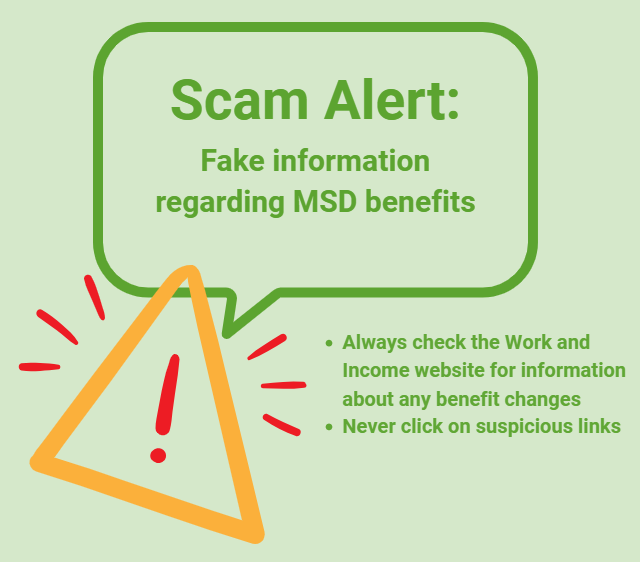
Scam Alert: Fake information regarding December Bonuses from MSD
The Ministry of Social Development is reporting that fake information is circulating about new ‘December bonuses’ or ‘benefit increases’
If you get suspicious communication, please contact Netsafe.
 Loading…