






Jobseeker Work Ready benefit numbers increase by 12% in a year
The Government says the benefit numbers have long been forecast to get worse before they get better – and there were “positive signs” its approach to social welfare was working.
But Labour says New Zealand families are continuing to suffer – and the Government is making the wrong decisions and mismanaging the economy.
There are two categories of Jobseeker benefits – “work ready” for those who can work now – and “health condition or disability” for those who can’t work right now for health reasons.
New data from the Ministry of Social Development (MSD) shows that between September 2023 and September 2024, the number of people receiving the weekly Jobseeker Work Ready payment increased by around 12,300 people or 11.8%.
People receiving the “health condition or disability” payment increased by 11,000 people or 14.3% compared with September 2023.
However, more recent month-on-month data shows the tide is starting to turn, at least for Jobseeker Work Ready numbers, which decreased by about 300 people or 0.2% in September 2024 from the previous month. This was the first decrease since April 2024.
The number of people receiving the health condition or disability payment increased by about 2000 people or 2.3% in September compared with the previous month.
Social Development and Employment Minister Louise Upston described rising unemployment as a “lingering consequence” of years of high inflation, high government spending, and periods of economic recession.
“Jobseeker numbers have long been forecast to get worse before they get better, and we knew this when we set our target to reduce the number of people on Jobseeker Support by 50,000 over six years,” Upston said.
“We’re already seeing positive signs that this Government’s more proactive approach to supporting job seekers is working, with the latest monthly stats showing more than 2000 people cancelling their Jobseeker Benefit because they found work between July and September compared to the same period last year.”
The coalition Government has been focused on Jobseeker beneficiary numbers and has a goal for 50,000 fewer recipients in the next six years.
The Government has ramped up its threat of sanctions for Jobseeker beneficiaries not fulfilling their work obligations by introducing new requirements (such as attending a seminar within a fortnight of starting the payment) and a new beneficiary traffic light system.
At the time, advocate Brooke Pao Stanley, who runs Auckland Action Against Poverty, said such moves to increase sanctions would not help people get into work and would instead cause further stress to vulnerable people already living in stressful situations.
Labour’s social development spokeswoman, Carmel Sepuloni, said the Government’s actions were “taking us backwards”.
“It’s a tough time for New Zealanders. They have made the deliberate decision to lay off thousands of public servants and have cut government investment in infrastructure, like for Dunedin Hospital and school builds.
“Beneficiary numbers are skyrocketing even past Treasury’s predictions. Ministers have made the wrong choices and are mismanaging the economy at the expense of New Zealand families who are suffering from growing unemployment.”
Overall figures for main benefits – which include Jobseeker benefits as well as other payments like Sole Parent Support and the Supported Living Payment – increased by about 2500 (0.6%) month-on-month and by 29,100 (8%) year-on-year.
===========================================
www.nzherald.co.nz...
==========================================

Today’s Mind-Bender is the Last of the Year! Can You Guess It Before Everyone Else? 🌟🎁🌲
I dance in the sky with green and gold, a spectacle few are lucky to behold; I’m best seen in the south, a celestial sight—what am I, lighting up the New Zealand night?
Do you think you know the answer? Simply 'Like' this post and we'll post the answer in the comments below at 2pm on the day!
Want to stop seeing these in your newsfeed? No worries! Simply head here and click once on the Following button.


Scamwatch: How to recognise, avoid and act against scams.
A scam or a fraud is any scheme designed to con you out of money or steal your personal information. If someone contacts you unexpectedly – whether over the phone, through the post, by email, on a website, in person or on social media – always consider the possibility that it may be a scam.
Scammers target lots of people, often for small amounts of money. They constantly evolve their approach making scams harder to spot. Most scams come from overseas, but they may pretend to be locally based — from a reputable company, bank, or government agency, or even from your friends on social media if your account has been hacked. It is very difficult to get your money back once it is sent overseas.
Scams hurt us all. You can protect yourself and others by learning how to spot scams, share what you see and report them.
Figure out if you are being scammed: Use these questions to help figure out if you have been targeted by a scammer.
Article compiled from information kindly supplied by ConsumerProtection.govt.nz
Q&A regarding Neighbourly data breach
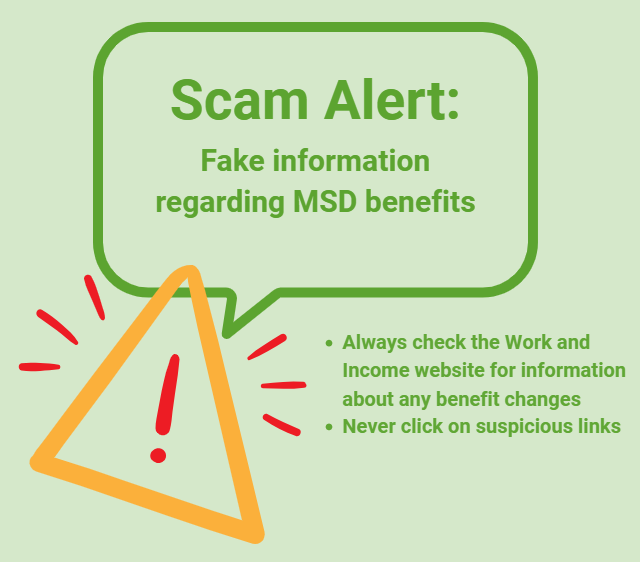
Scam Alert: Fake information regarding December Bonuses from MSD
The Ministry of Social Development is reporting that fake information is circulating about new ‘December bonuses’ or ‘benefit increases’
If you get suspicious communication, please contact Netsafe.
 Loading…